Insights & Guides
Marine Mechanic Insurance: Key Risks to Consider
A marine mechanic works in an environment that combines the risks of a land-based workshop with the additional exposures of boats on slipways, trailers, water access and outboard engine work. Standard motor trade policies were written with cars and trucks in mind. Here is how cover for marine mechanics needs to be structured differently.
Quick summary
- Marine trade work creates liability exposures that differ from land-based vehicle repair, particularly around slipways and water access.
- Boats in your care represent a different valuation challenge from vehicles - hull, motor and electronics values vary significantly.
- Standard motor trade road risk does not extend to moving vessels on trailers or operating a slipway - this needs specific attention.
- Tools and diagnostic equipment for modern marine engines carries high replacement values, including MFD programming units.
- Workers compensation still applies to marine mechanic employees, with the injury profile shaped by working on or near water.
- A marine-aware broker can identify whether your cover was written for automotive work and whether it extends to marine trade activities.
Summarise this with AI
Open a quick summary of this guide in your preferred AI assistant.
Why marine trade work needs specific attention
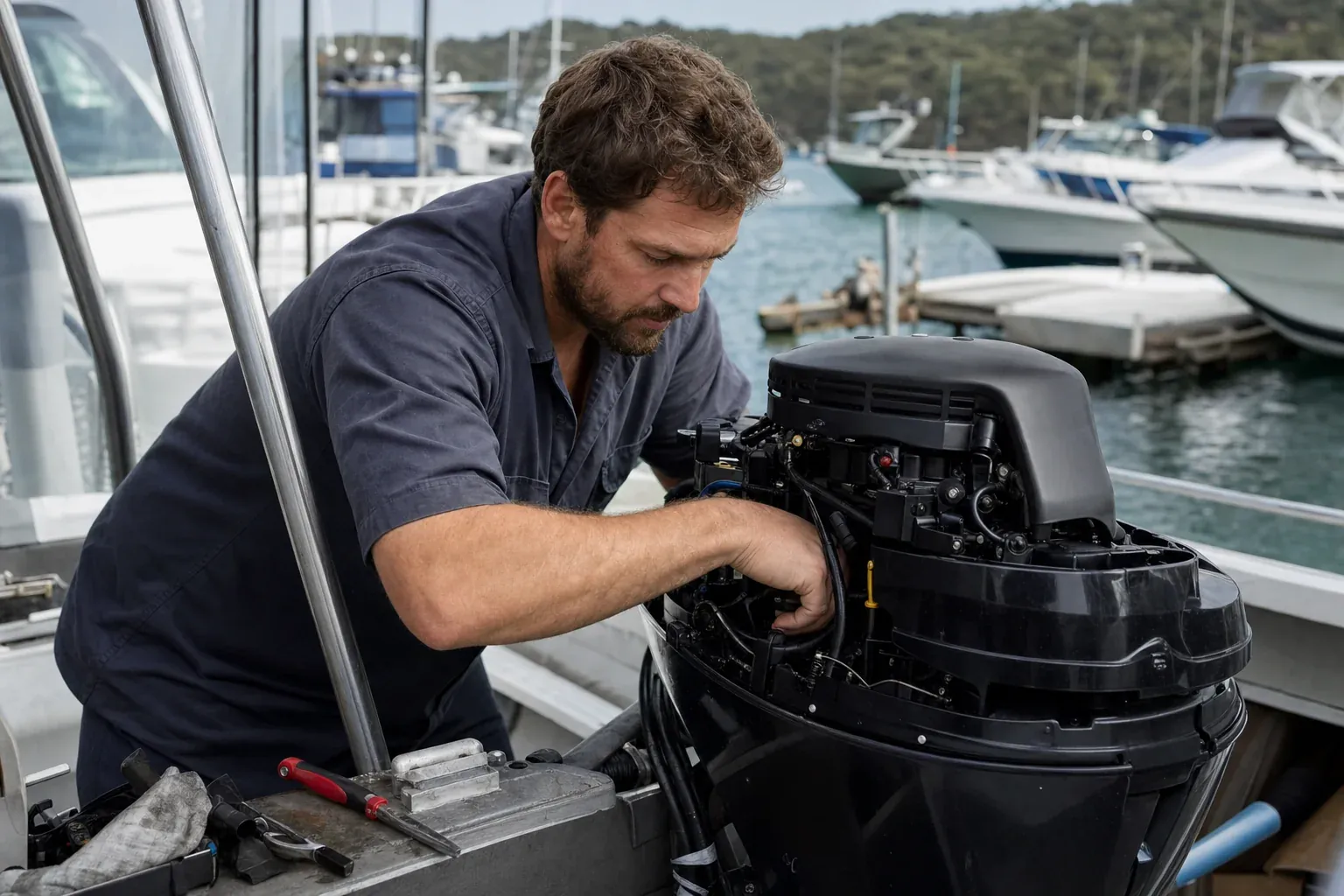
A marine mechanic servicing outboard engines, sterndrives, inboard diesel and petrol engines, and marine electrical systems operates in a genuinely different environment from an automotive workshop. Boats arrive on trailers or via a slipway. They may be lifted out of the water and placed in a hardstand area. Work is often performed with the vessel in or near the water, or with the technician working in a confined bilge space.
The risk environment reflects that difference. A vessel slipping off a trailer during launch is a different scenario from a car rolling off a hoist. An outboard engine falling from a transom during service has different consequences depending on whether the boat is on land or in the water at the time. A fire in a bilge during fuel system work carries different risks from a workshop floor fire.
Insurance cover for a marine mechanic needs to have been arranged with those scenarios in mind, not simply assumed to extend from an automotive motor trade policy.
Liability exposures specific to marine work
Public liability covers your legal liability to third parties for injury or property damage arising from your business activities, and that applies equally in the marine trade. But the third-party scenarios in a marine environment are different from those in an automotive workshop.
- A customer or member of the public slipping on a wet slipway near your operation
- A vessel being launched from your slipway that has not been correctly secured and collides with another boat
- Damage to an adjacent vessel on the hardstand caused by a falling component or equipment during a repair
- Fuel system work that results in a fuel spill into the water, creating an environmental liability
- An outboard engine that is not correctly remounted and separates from the transom after launch, causing damage or injury
- Trailer movement on a slope that results in a vessel or trailer striking third-party property
Environmental liability is a specific concern in marine trade work. A fuel spill into a waterway, harbour, or marina can trigger a cleanup obligation and liability to third parties that does not arise in a land-based workshop context. If your work involves fuel system repairs on vessels in or near water, it is worth confirming whether your liability cover extends to this type of environmental loss.
Boats in your care and the valuation challenge
Garage keeper's liability, the cover for property in your care, custody or control, applies to boats in your marine workshop just as it does to vehicles in an automotive workshop. The valuation challenge is different, however, because a boat's total value is spread across the hull, the engine or engines, the electronics package, and the trailer.
A modern runabout with twin outboard engines and a quality chartplotter, VHF radio, fishfinder, and trim tabs can represent a significant total insured value. A larger sports cruiser or game fishing vessel adds to that considerably. If a boat is damaged in your hardstand by a falling structure, a fire, or weather event, the claim needs to be assessed against the full vessel value, not just the engine you were working on.
The limit on your garage keeper's or marine care, custody and control cover should reflect the maximum value of the highest-specification vessel you might hold on the premises, not an assumed average.
Tools and equipment for marine mechanics
Modern outboard and sterndrive engines from manufacturers including Mercury, Yamaha, Suzuki, Honda, Volvo Penta, and Evinrude Johnson require dedicated diagnostic software and interfaces. Dealer-level diagnostic units for outboard brands are expensive to replace, and they are the kind of specialist items that may sit above the per-item sub-limit in a general tools policy unless they are individually specified.
Beyond diagnostics, marine mechanic tools include compression testers adapted for marine cylinder configurations, trim and tilt system testing equipment, prop shaft alignment tools, and cooling system pressure testing kits for closed-cooling inboard systems. These are trade-specific and cannot always be sourced quickly from general tool suppliers, which means downtime from an uninsured loss is a real business problem.
We can help you review whether your tools and equipment schedule captures the marine-specific equipment you rely on at the right value.
Workers compensation and return to work in the marine trade
Working on vessels on a slipway, in a bilge space, or in a waterfront hardstand creates a specific set of injury risks for marine mechanic employees. Working at height when boarding larger vessels, working in confined spaces with fuel vapour present, and manual handling on wet or uneven surfaces are all considerations that inform the injury profile of the trade.
Workers compensation applies in every Australian state and territory from the first day of employment. For a marine trade business, the applicable state scheme is the one where the worker is ordinarily employed. If your technicians regularly travel to service vessels at remote marinas or moorings in other states, it is worth confirming how your state scheme applies to that work.
Frequently Asked Questions
Not necessarily. Standard motor trade policies are written around cars and trucks, and the scenarios specific to marine trade work, including slipways, vessels in the water, trailers, and marine environmental liability, may not be clearly addressed in the wording. We can review your current cover and identify whether marine trade activities are explicitly included or whether there are gaps.
Related Cover & Guides
This guide is general information only and does not take your specific circumstances into account. Mechanics Insurance is an insurance broker. We help you review and arrange cover, we do not underwrite or issue policies. Cover terms, limits and exclusions vary by policy and insurer.
Ready to Sort Your Cover?
Tell us about your business and we will help you review your options, no obligation.